Commercial Umbrella Insurance in CT: Do You Have Enough Coverage?
What commercial umbrella insurance in Connecticut actually does
Commercial umbrella insurance in Connecticut is one of those coverages that feels optional right up until the moment you need it. It works as a second layer of protection that sits on top of your existing liability policies. When a claim exhausts the limits on your general liability, commercial auto, or employers liability coverage, the umbrella picks up the remaining costs. Without it, your business absorbs whatever is left, and in today's legal environment that can mean six or seven figures coming out of your operating account or personal assets.
How a commercial umbrella policy works
A commercial umbrella does not stand alone. It requires underlying policies, and it only pays after those underlying limits are fully exhausted. Here is a straightforward example: your general liability policy has a $1 million per-occurrence limit. A customer is seriously injured at your Milford warehouse, and the jury awards $2.3 million. Your general liability pays the first $1 million. A $1 million commercial umbrella would then cover the next $1 million, leaving your business responsible for only $300,000. A $2 million umbrella covers the gap entirely.
Common underlying policies that a commercial umbrella sits over include:
- Commercial general liability : covers bodily injury and property damage claims from third parties at your business location or arising from your operations.
- Commercial auto liability : covers accidents involving your business vehicles where your drivers are at fault.
- Employers liability : the part of a workers compensation policy that covers lawsuits brought by injured employees beyond the statutory workers comp benefit.
- Hired and non-owned auto liability : covers vehicles your employees use for business that your company does not own.
The umbrella adds limits above all of these with a single policy and a single premium, which makes it a cost-efficient way to increase total liability protection.
Excess liability vs. commercial umbrella: the difference matters
These two terms are often used interchangeably, but they are not the same product. An excess liability policy raises the limit on one specific underlying policy, nothing more. A commercial umbrella can broaden coverage in addition to adding limits. In some cases it will respond to a claim that the underlying policy does not even cover, depending on the policy language. For most Connecticut small and mid-size businesses, a true umbrella is the better choice because it provides both added limits and added breadth. Ask your broker to confirm which product you are actually being quoted.
Who needs commercial umbrella insurance in Connecticut
Most businesses that have any meaningful customer contact, vehicle use, or physical location should carry this coverage. Certain Connecticut industries face elevated risk and should treat it as required rather than optional.
Contractors and construction trades
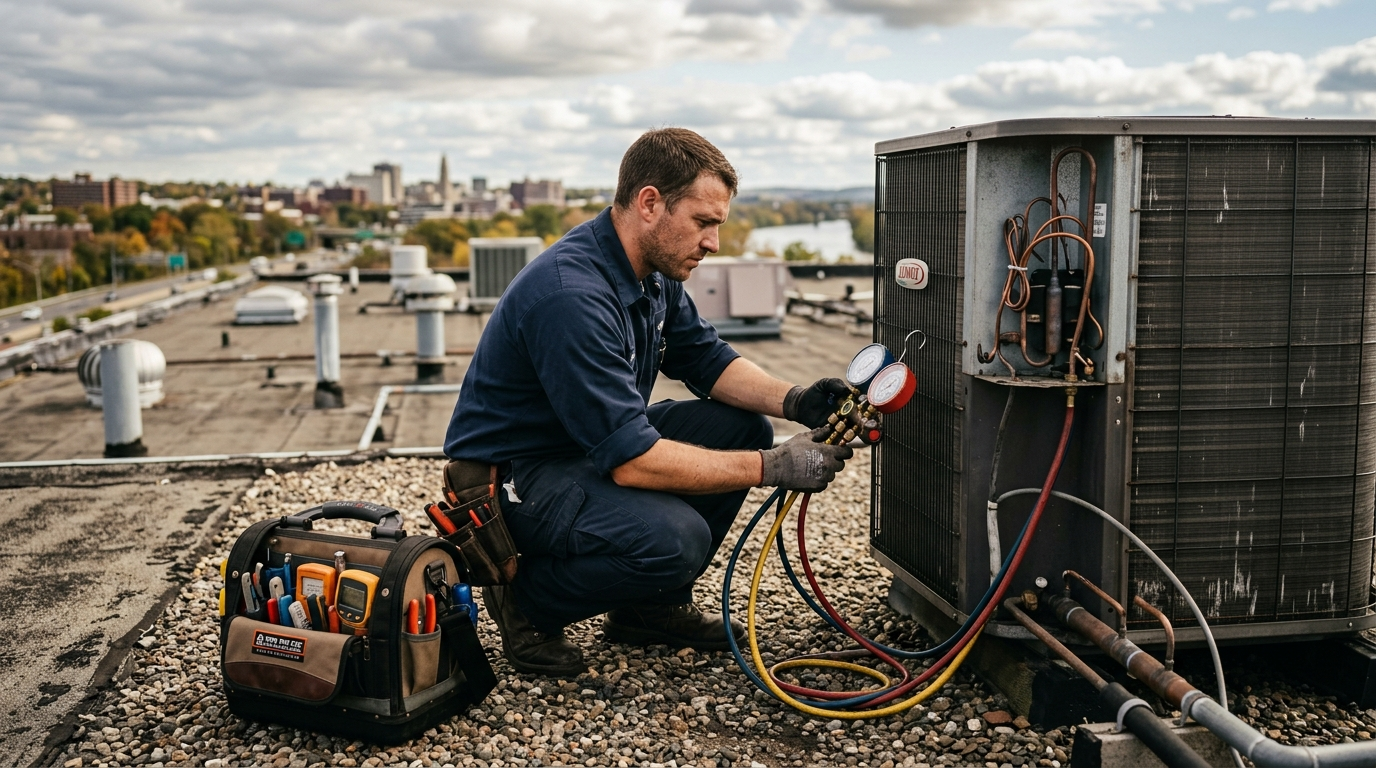
General contractors, electricians, plumbers, HVAC installers, and excavation companies regularly work on job sites with high injury potential. A single serious accident, a collapsed trench, a fall from scaffolding, or a gas line nick can generate a lawsuit that blows through a $1 million general liability limit before the case gets to trial. Many Connecticut project owners and general contractors require subcontractors to carry umbrella limits of $2 million to $5 million before allowing them on site.
Restaurants and food service
Liquor liability claims, slip-and-fall incidents, and foodborne illness lawsuits can all reach seven figures when serious injury or death is involved. A busy New Haven or Fairfield restaurant serving alcohol is one bad incident away from a claim that exceeds standard policy limits.
Property management and commercial real estate
Property managers and landlords face premises liability claims from tenants, visitors, and delivery personnel. An icy parking lot in January, a poorly lit stairwell, a broken railing: Connecticut courts have produced multimillion-dollar verdicts in premises liability cases, and that trend has not reversed.
Manufacturers and distributors
Product liability claims are among the most expensive in the country. If a product your Connecticut facility manufactures or ships causes bodily injury, the lawsuit will name every company in the supply chain. Umbrella limits of $5 million or more are common in this sector.
Home healthcare and professional service firms
Healthcare workers enter private homes and provide services that directly affect people's health. A negligence allegation in that context can be both a professional liability matter and a general liability matter, and costs escalate quickly.
How much coverage do Connecticut businesses actually need
There is no state-mandated minimum for commercial umbrella coverage in Connecticut, so the decision is driven by your risk profile, contractual requirements, and asset exposure. Practical benchmarks used as starting points include:
- $1 million umbrella : a reasonable floor for low-risk service businesses with limited physical contact and no vehicle fleet.
- $2 to $5 million umbrella : appropriate for most contractors, retailers, restaurants, and businesses with significant foot traffic or vehicle use.
- $5 million and above : warranted for manufacturers, large property portfolios, healthcare operations, and any business with contractual requirements from institutional clients or government contracts.
One useful rule of thumb: add up the total value of your business assets, including equipment, receivables, and real property. Your total liability coverage (underlying limits plus umbrella) should be at least equal to that number. Plaintiffs' attorneys will estimate what you are worth before deciding how hard to pursue a judgment.
The cost of a commercial umbrella policy is usually far lower than business owners expect. A $1 million umbrella for a small Connecticut contractor might run $500 to $1,500 per year depending on payroll, revenues, and operations. A $2 million policy for a mid-size restaurant might cost $1,200 to $2,500 annually. Those premiums represent a fraction of the exposure they cover.
Common gaps that leave Connecticut businesses underprotected
Even businesses that carry an umbrella policy sometimes discover at claim time that it does not cover what they assumed. Watch out for these situations:
Professional liability is excluded
Most commercial umbrella policies exclude claims arising from professional errors or omissions. If your business provides advice, design, technology services, or healthcare, a separate professional liability policy covers those claims, and your umbrella will not fill that gap unless it is specifically endorsed to do so.
Underlying limits are too low
An umbrella policy only pays after the underlying policy pays its full limit. If your general liability has a $500,000 limit and the umbrella requires a $1 million underlying limit, you have a gap in the middle. Make sure your underlying policy limits match the "retained limit" requirements in the umbrella form.
The umbrella does not follow the underlying policy
When you add a new underlying policy mid-term, such as a hired and non-owned auto policy for a new delivery operation, you need to update the umbrella schedule to include it. Otherwise that policy sits outside the umbrella's coverage tower.
Intentional acts and pollution
Standard umbrella policies exclude intentional acts and most pollution events. Businesses that handle chemicals, fuels, or other regulated materials should ask about a separate pollution liability policy rather than assuming the umbrella will respond.
Pairing umbrella coverage with the right underlying program
A commercial umbrella is only as strong as the policies beneath it. For most Connecticut small businesses, that foundation starts with a solid business owners policy, which bundles general liability and commercial property into one package. From there, depending on your operations, you add commercial auto, workers compensation, and any specialized coverages your industry requires.
The goal is a coverage tower with no gaps between layers. When one policy ends, the next one begins. An independent agent who understands your operations can map that tower clearly and show you exactly what is covered at each level and where the umbrella takes over. That kind of review is worth doing annually, especially as your revenue, payroll, and asset values grow, because each of those factors affects how much exposure you actually carry.
Connecticut businesses operating in multiple states, or that send employees to job sites in neighboring states like New York, should also confirm that both their underlying policies and the umbrella respond to out-of-state claims. Some policy forms restrict coverage to a single state or listed territory.
Get the right commercial umbrella coverage for your Connecticut business
At United Insurance Group , we are an independent insurance agency, which means we shop your coverage across multiple carriers to find the combination of limits, terms, and price that fits your actual operation, not just the easiest policy to place. We work with businesses across Connecticut, from Hamden and New Haven to Fairfield County towns like Trumbull, Shelton, and Milford, and we understand the liability environment Connecticut businesses face every day.
If you are not sure whether your current limits are adequate, or if you have never had a formal review of your coverage tower, now is a good time to take a look. A gap you do not know about today can become a very expensive problem tomorrow. Reach out to our team at (203) 795-0275 or request a quote online and we will put together a comparison across carriers so you can make an informed decision. You can also explore our full range of commercial insurance options to see how umbrella coverage fits into a complete business insurance program.
Get A Quote
At United Insurance Group, securing your future is easy. Ready to protect what matters? Contact us for a quick quote and personalized insurance options!
Meet, James
Your 24/7 Insurance Assistant • English & Spanish
Start your custom insurance quote
Instant answers to your insurance questions
Schedule appointments or follow-ups
Personal Insurance
From auto and homeowners to renters and umbrella policies, we help protect your family and property. Let’s find coverage that fits your life.
Commercial Insurance
We customize policies for your industry's risks, like general liability and workers' comp, ensuring you can run your business worry-free.
Contact United Insurance Group
Recent Posts